As an Amazon Associate I earn from qualifying purchases.
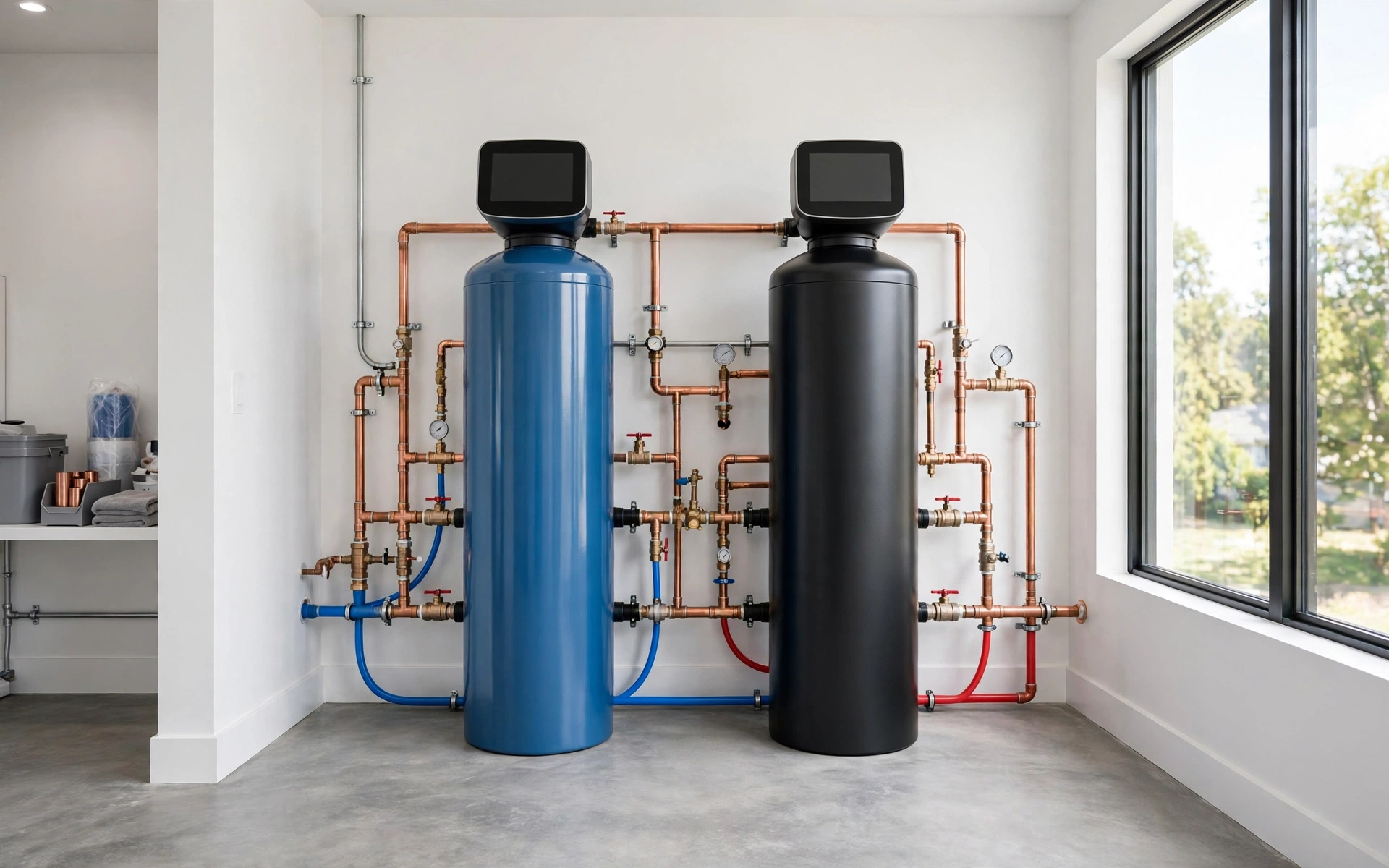
Best Whole House Water Softeners for Large Homes in 2026
Best Whole House Water Softeners for Large Homes in 2026 Large homes require water softeners with higher grain capacities and efficient regeneration cycles t...
Review
Best Whole House Water Softeners for Large Homes in 2026
Best Whole House Water Softeners for Large Homes in 2026 Large homes require water softeners with higher grain capacities and efficient regeneration cycles t...
Fast answer
Large homes with high water usage need carefully sized water softeners to handle hard water efficiently. This guide explains how to calculate grain capacity, compares salt based and salt free systems, and reviews the best 2026 models for large households.
- The 'Large Home Capacity Score' (LHCS) is the central unique element. It's a simple scoring system applied within the comparison table, rating products on a 1-5 scale for: 1) Capacity vs. Calculated Need, 2) Regeneration Efficiency (salt/water waste), 3) Smart Feature Utility for Large Homes, and 4) Well Water Compatibility. This synthesizes complex data into an at-a-glance buyer aid.
- A single-tank ion exchange water softener system typically costs $1,200 to $3,800 installed, with budget options starting at $800. Source: https://www.homebuddy.com/costs/water-treatment-system/cost-to-install-water-softener
- Whole-house reverse osmosis systems can exceed $10,000. Source: https://www.homebuddy.com/costs/water-treatment-system/cost-to-install-water-softener
- Ongoing operating costs for water softeners average $100 to $300 per year for salt, filter changes, and occasional professional servicing. Source: https://www.homebuddy.com/costs/water-treatment-system/cost-to-install-water-softener
- NSF/ANSI Standard 44 specifically addresses cation exchange water softeners, verifying their effectiveness in removing calcium and magnesium ions. Source: https://qualitywatertreatment.com/pages/what-are-nsf-certified-best-value-water-softener-systems
Our top picks
Best Whole House Water Softeners for Large Homes in 2026
Large homes require water softeners with higher grain capacities and efficient regeneration cycles to manage significant water usage and hard water effectively. This guide provides a precise sizing method, cost insights, and the best 2026 options tailored for large households.
What defines a 'large home' for water softener sizing?
For water softener sizing, a 'large home' is defined by water consumption rather than square footage. Typically, it refers to households using over 75 gallons of water per person daily, with 5 or more occupants, 4 or more bathrooms, or water hardness exceeding 10 grains per gallon (GPG).
Key indicators of a large home include:
- 5 or more residents
- 4 or more bathrooms
- Daily water use exceeding 350 gallons
- Water hardness above 10 GPG
- Presence of well water or elevated iron content
For example, the DuraWater EDW-Soft Elite Series with a 64,000 grain capacity is designed specifically for homes with substantial water usage, making it ideal for large households.
Sizing your water softener based on actual water use and hardness ensures efficient operation and reduces frequent regeneration interruptions.
How do I calculate the exact grain capacity my large home needs?
Calculate your water softener's grain capacity by multiplying your home's daily water use (in gallons) by the water hardness (in GPG), then multiply by 7 to cover a full regeneration cycle.
Formula: Grain Capacity = Daily Water Use (gal) × Hardness (GPG) × 7
Example: A family of 5 using 400 gallons daily with 12 GPG hardness requires a minimum of 33,600 grains capacity. Selecting a system with a buffer, such as 40,000 to 48,000 grains, reduces regeneration frequency and improves efficiency.
| Example Scenario | Daily Water Use (gal) | Hardness (GPG) | Minimum Grain Capacity |
| Family of 4, Moderate Use | 300 | 10 | 21,000 |
| Family of 5, High Use | 400 | 12 | 33,600 |
| Family of 6, Severe Hard | 500 | 15 | 52,500 |
Accurate grain capacity calculation is essential to avoid common mistakes like under-sizing, which leads to frequent regeneration and inefficiency.
Salt-Based vs. Salt-Free: Which is truly better for a large home?
Salt-based ion exchange softeners are generally superior for large homes with moderate to severe water hardness. They effectively remove calcium and magnesium ions and offer cost efficiency over time despite higher maintenance.
Salt-free conditioners prevent scale buildup but do not remove hardness minerals. They are better suited for homes with lower hardness levels or where salt use is restricted.
| Feature | Salt-Based Softeners | Salt-Free Conditioners |
| Hardness Removal | Removes calcium and magnesium ions | Does not remove hardness minerals |
| Maintenance | Requires salt refills and regeneration | Minimal maintenance, no salt needed |
| Water Usage | Uses water during regeneration | No water used for regeneration |
| Efficiency | High for severe hardness | Better for mild hardness |
| NSF/ANSI 44 Certified | Yes, verifies ion exchange efficacy | No specific NSF standard for softening |
NSF/ANSI Standard 44 certification confirms the effectiveness of salt-based systems in removing hardness ions, a critical consideration for large homes.
Salt-based softeners remain the most reliable solution for large homes facing hard water challenges.
What are the hidden long-term costs of a high-capacity softener?
Installation costs typically range from $1,200 to $3,800. Annual operating expenses for salt, filter replacements, and occasional servicing average between $100 and $300.
The most significant hidden cost is inefficient regeneration, which wastes water and salt. Systems equipped with efficient valves like the Fleck 5600SXT minimize waste and reduce operating costs.
| Cost Component | Estimated Range |
| Installation | $1,200 - $3,800 |
| Annual Salt & Filters | $100 - $300 |
| Water for Regeneration | Varies; efficiency impacts cost |
For example, the Aquasure Harmony Series 48 features a Fleck 5600SXT valve that optimizes regeneration efficiency, lowering salt and water waste.
Choosing a softener with high regeneration efficiency saves money and resources over the system's lifespan.
Which water softeners are best for large homes in 2026? (Comparison Table)
Below are top recommended water softeners for large homes, selected based on capacity, efficiency, and features. Prices and availability may vary; verify current details before purchase.
| Product Name | Grain Capacity | Key Feature | Best For | NSF Certified | Estimated Price Tier |
| DuraWater EDW-Soft Elite Series | 64,000 | Digital control, high capacity | Very large homes, high water use | Yes | Premium |
| Aquasure Harmony Series 48 | 48,000 | Fleck 5600SXT valve | Moderate to severe hardness | Yes | Mid-range |
| GE GXSH40V Water Softener | 40,000 | Smart connectivity | Tech-savvy homeowners | Yes | Mid-range |
| AFW Filters IRONPRO 2 Combination | 32,000+ | Softener + iron filter | Well water with iron and hardness | Yes | Mid-range |
| Aquasana Rhino Well Water Filter | N/A | Whole-house filtration | Well water filtration | Yes | Premium |
| iSpring RCC7AK 6-Stage RO Filter | N/A | Under-sink RO system | Drinking water quality | Yes | Mid-range |
| Culligan WH-S200-C Filter System | N/A | Sediment and carbon filter | Whole-house filtration | Yes | Mid-range |
Note: Prices and product features may change by 2026. Always confirm current specifications and certifications.
Selecting a water softener with the right capacity and features ensures long-term satisfaction and efficiency.
How do I choose between a softener, a filter, or a combination system?
Choose a water softener if hardness is your only concern. Add a whole-house filter like the Aquasana Rhino for sediment, chlorine, or other contaminants. Use a combination system such as the AFW Filters IRONPRO 2 if your water has both high hardness and iron levels above 3 ppm, common in well water.
This decision tree helps address specific water issues effectively:
- Hardness only: Salt-based softener
- Hardness plus sediment/chlorine: Softener + whole-house filter
- Hardness plus iron: Combination softener/iron filter system
Ignoring specific water problems like iron can reduce system effectiveness and increase maintenance.
What should I look for during installation in a large home?
High-capacity water softeners require adequate space due to larger tanks and brine tanks. Ensure proper drainage for regeneration cycles and easy access to bypass valves for maintenance.
Consider professional installation for complex plumbing or integration with well water systems. Key installation considerations include:
- Sufficient physical space for unit and brine tank
- Proper drainage setup for regeneration wastewater
- Accessibility for salt refills and servicing
- Compatibility with existing plumbing and water pressure
Planning installation carefully prevents operational issues and costly modifications later.
Conclusion: Your Decision Framework for 2026
- Test your water hardness and iron content. 2) Calculate your daily water use accurately. 3) Use the formula (Daily Use × Hardness × 7) to determine minimum grain capacity. 4) Choose systems with NSF/ANSI 44 certification and efficient regeneration valves like Fleck 5600SXT. 5) Factor in 10-year cost of ownership including installation, salt, water, and maintenance.
This framework ensures you select a water softener that meets your large home's needs efficiently and cost-effectively in 2026 and beyond.
Recommended Resources
How do I determine the right size (grain capacity) water softener for my large home?
What's the difference between a 48,000 grain and a 64,000 grain water softener, and which is better for a large home?
Are smart water softeners worth the investment for large households?
Can a whole-house water softener also filter drinking water effectively?
What are the ongoing maintenance costs for a whole-house water softener in a large home?
Is NSF certification important for water softeners, especially for large homes?
Recommended Resources

Lead researcher and home comfort specialist at House By Saay. Specializes in ergonomic design, sleep technology, and consumer product durability analysis.
Sources
- https://softprowatersystems.com/pages/ultimate-comparison-of-water-softeners-guide
- https://qualitywatertreatment.com/pages/what-are-nsf-certified-best-value-water-softener-systems
- https://www.homebuddy.com/costs/water-treatment-system/cost-to-install-water-softener
- https://hellawater.com/average-water-softener-cost-2026-prices-installation-guide/
Comments
Join the conversation
Leave a simple comment about Best Whole House Water Softeners for Large Homes in 2026.
No comments yet. Be the first to comment.