As an Amazon Associate I earn from qualifying purchases.
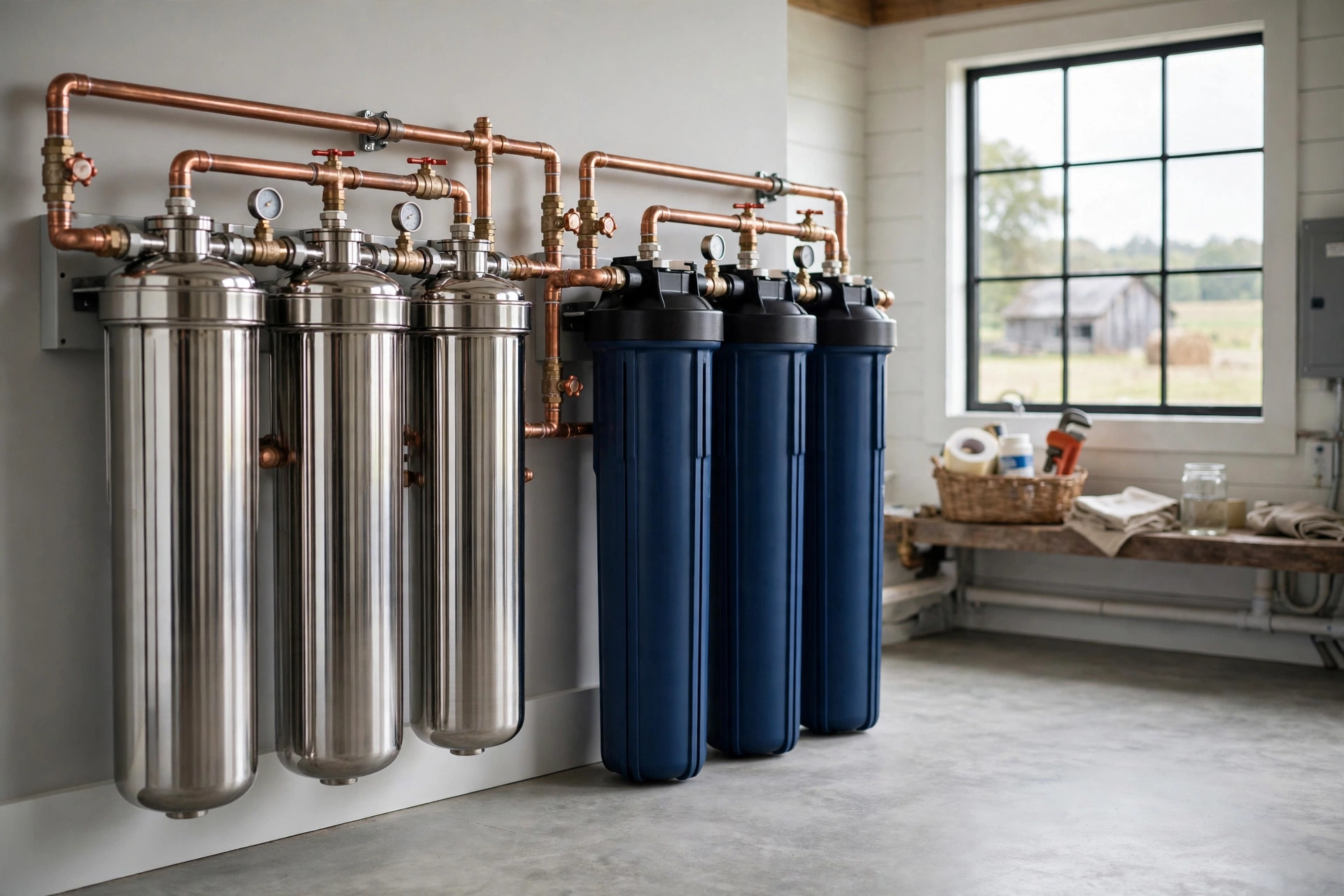
Aquasana Rhino vs Culligan Whole House Filter: Well Water Tested
Aquasana Rhino vs Culligan Whole House Filter: Well Water Tested The Aquasana Rhino generally outperforms the Culligan WH-S200-C in removing a broader range ...
Review
Aquasana Rhino vs Culligan Whole House Filter: Well Water Tested
Aquasana Rhino vs Culligan Whole House Filter: Well Water Tested The Aquasana Rhino generally outperforms the Culligan WH-S200-C in removing a broader range ...
Fast answer
For homeowners relying on well water, choosing the right whole house filter is critical. This article compares the Aquasana Rhino and Culligan WH S200 C systems, focusing on well water contaminants, costs, installation, and performance to help you make an informed decision.
- A 5-year total cost of ownership analysis tailored to well water maintenance needs, and a visual decision flowchart that starts with water test results to guide the choice between these two specific models and other product types (softeners, iron filters, RO).
- Aquasana SimplySoft® water softener has a 95 GPG capacity. Source: https://softprowatersystems.com/pages/ultimate-comparison-of-water-softeners-guide
- The premium Aquasana SimplySoft® costs $799.99 and includes an integrated pre-filter and robust warranty protection. Source: https://qualitywatertreatment.com/pages/what-are-nsf-certified-best-value-water-softener-systems
- NSF/ANSI Standard 44 specifically addresses cation exchange water softeners, verifying their effectiveness in removing calcium and magnesium ions. Source: https://qualitywatertreatment.com/pages/what-are-nsf-certified-best-value-water-softener-systems
- Many local building codes require NSF certification for water treatment solutions. Source: https://qualitywatertreatment.com/pages/what-are-nsf-certified-best-value-water-softener-systems
Our top picks
Aquasana Rhino vs Culligan Whole House Filter: Well Water Tested
The Aquasana Rhino generally outperforms the Culligan WH-S200-C in removing a broader range of well water contaminants such as iron, manganese, and hydrogen sulfide, while Culligan excels at sediment and chlorine reduction. Your choice should be based on your well water test results, budget, and household water demands.
Which system is better for removing common well water contaminants?
Aquasana Rhino targets a wider range of well water contaminants including heavy metals and hydrogen sulfide, whereas Culligan WH-S200-C focuses mainly on sediment, chlorine, and taste/odor improvement.
Well water often contains iron, manganese, sulfur compounds, and sediment that require specialized filtration. The Aquasana Rhino Whole House Well Water Filter System is designed specifically for these challenges, featuring a multi-stage filtration process that removes up to 97% of chlorine, reduces iron, manganese, hydrogen sulfide (rotten egg smell), and sediment down to 5 microns. Its 1,000,000-gallon capacity suits long-term use.
In contrast, the Culligan WH-S200-C system uses sediment and carbon filtration media to reduce chlorine, sediment, and improve taste and odor but does not specifically target iron or hydrogen sulfide. It is better suited for well water with primarily sediment or chlorine issues.
For severe iron or hardness problems, consider specialized systems like the AFW Filters IRONPRO 2, which combines iron filtration and softening, or the Aquasure Harmony Series 48 water softener for hardness.
| Contaminant | Aquasana Rhino Removal | Culligan WH-S200-C Removal |
| Iron | Yes (moderate levels) | No |
| Manganese | Yes | No |
| Hydrogen Sulfide | Yes | No |
| Sediment | Yes (5 micron) | Yes (sediment filter) |
| Chlorine | Yes (activated carbon) | Yes (carbon filter) |
| Taste & Odor | Yes | Yes |
Aquasana Rhino is the superior choice for well water with iron and sulfur issues, while Culligan suits sediment and chlorine concerns.
How do the long-term costs and maintenance compare?
Aquasana Rhino has a higher upfront cost but offers a 1,000,000-gallon filter lifespan, while Culligan has a lower initial cost but requires more frequent filter replacements, making the 5-year costs comparable.
Aquasana Rhino’s premium system price is typically around $1,200, with professional installation costs averaging $800 for well water setups. Its filters last up to 1,000,000 gallons, often translating to 5-7 years before replacement, reducing ongoing expenses.
Culligan WH-S200-C is more budget-friendly initially, around $600, but its filters need replacement approximately every 6-12 months, costing about $150 annually. Installation costs are similar, around $800.
Operating costs for water treatment systems average $100 to $300 per year, including filter replacements and occasional servicing.
| Cost Component | Aquasana Rhino (5 Years) | Culligan WH-S200-C (5 Years) |
| System Price | $1,200 | $600 |
| Professional Install | $800 | $800 |
| Filter Replacements | $200 (1 replacement) | $750 (5 replacements) |
| Total Estimated Cost | $2,200 | $2,150 |
Warranty coverage for Aquasana is robust, often including extended protection on the system and filters. Culligan offers standard warranties but may require more frequent part replacements.
Long-term, Aquasana’s durable filters reduce maintenance frequency, balancing its higher upfront cost.
What are the installation requirements for a well water setup?
Both systems require installation after the well pump and before the water heater, with a sediment pre-filter recommended for heavy sediment well water; professional installation is advised.
Well water systems typically need a bypass valve, pressure gauge, and sometimes a dedicated sediment pre-filter to protect the main filter and plumbing. Both Aquasana Rhino and Culligan WH-S200-C require these components for optimal performance.
Professional installation ensures proper pressure management and bypass setup, especially important for well water with variable pressure and sediment loads. Installation costs range from $1,200 to $3,800 depending on complexity and region.
DIY installation is possible for experienced homeowners but not recommended for well water systems due to complexity and local code requirements.
Professional installation safeguards system longevity and water quality in well water applications.
Which system has better flow rate and capacity for my household?
Aquasana Rhino supports higher flow rates and larger capacities suitable for bigger households, while Culligan’s flow rate is adequate for smaller to medium homes but should be verified for simultaneous appliance use.
Aquasana Rhino is rated for up to 7 gallons per minute (GPM), supporting multiple fixtures running simultaneously in larger homes. Culligan WH-S200-C typically supports around 6 GPM, which may suffice for smaller households.
Calculating peak household demand involves summing flow rates of simultaneous water uses (e.g., showers, washing machines). Aquasana’s higher capacity and flow rate make it preferable for families with heavy water use.
Water softeners like the Aquasure Harmony Series 48 and GE GXSH40V also factor capacity in grains (e.g., 40,000 to 48,000 grains) which impacts flow and regeneration frequency.
| System | Max Flow Rate (GPM) | Capacity (Gallons or Grains) |
| Aquasana Rhino | 7 | 1,000,000 gallons |
| Culligan WH-S200-C | 6 | Filter lifespan varies |
| Aquasure Harmony 48 | N/A (softener) | 48,000 grains |
| GE GXSH40V | N/A (softener) | 40,000 grains |
Aquasana Rhino’s higher flow rate supports larger households with well water demands.
How important are NSF certifications for well water filters?
NSF certifications verify that water treatment systems meet safety and performance standards; they are essential for well water filters to ensure contaminant removal claims are valid.
Aquasana Rhino meets NSF/ANSI Standard 42 for chlorine and taste/odor removal and Standard 53 for health-related contaminants. Culligan WH-S200-C is certified to NSF/ANSI Standard 42 for chlorine and sediment reduction but does not hold certifications for iron or hydrogen sulfide removal.
NSF/ANSI Standard 44 applies to water softeners and verifies effective removal of hardness minerals like calcium and magnesium. Many local building codes require NSF certification for water treatment systems.
Choosing a system with relevant NSF certifications ensures compliance and verified performance, critical for well water treatment.
What do real user reviews say about performance on well water?
Aquasana Rhino users report significant reduction in iron staining and elimination of rotten egg odors caused by hydrogen sulfide. Many praise its long filter life and improved water clarity.
Culligan WH-S200-C users note clearer water and improved taste, especially where sediment and chlorine were primary issues. Some mention the need for frequent filter changes and occasional pressure drops.
Both systems require correct sizing and professional installation for optimal results. User feedback highlights the importance of matching system capabilities to specific well water contaminants.
Conclusion: How to choose between Aquasana Rhino and Culligan for your well
Start with a comprehensive well water test to identify contaminants. If your water has high iron, manganese, or hydrogen sulfide, the Aquasana Rhino is the better choice for comprehensive removal.
If your well water issues are mainly sediment, chlorine, or taste and odor, the Culligan WH-S200-C offers a cost-effective solution.
Consider your household size and peak water demand; Aquasana supports higher flow rates and larger capacities.
Factor in installation complexity and budget. Professional installation is recommended for both.
For drinking water polish, consider adding an under-sink reverse osmosis system like the iSpring RCC7AK. For salt-free conditioning, NuvoH2O offers complementary options.
This decision framework ensures you select the system best suited to your well water quality and household needs.
Recommended Resources
What is the difference between a whole-house water filter and a water softener?
Why is NSF certification important when choosing a water treatment system?
How do I test my well water to determine what type of filtration I need?
What are the typical costs for installing and maintaining a whole-house well water filter?
Can I install a whole-house water filter for well water myself, or should I hire a professional?
What are the common signs that my well water needs filtration or softening?
Recommended Resources

Lead researcher and home comfort specialist at House By Saay. Specializes in ergonomic design, sleep technology, and consumer product durability analysis.
Sources
- https://softprowatersystems.com/pages/ultimate-comparison-of-water-softeners-guide
- https://qualitywatertreatment.com/pages/what-are-nsf-certified-best-value-water-softener-systems
- https://www.homebuddy.com/costs/water-treatment-system/cost-to-install-water-softener
- https://hellawater.com/average-water-softener-cost-2026-prices-installation-guide/
Comments
Join the conversation
Leave a simple comment about Aquasana Rhino vs Culligan Whole House Filter: Well Water Tested.
No comments yet. Be the first to comment.